HP45-format cartridges, filled in house
The TIJ 2.5 body, a 42 ml industrial fill, and ink we formulate ourselves. Two families cover almost every enquiry we get: a fast-dry solvent ink for surfaces that will not absorb anything, and a covert UV ink for marks that are not meant to be seen.
TIJ 2.5 Solvent Cartridge
Fast-dry solvent ink for HDPE, PP, PET, rigid PVC, coated metal, metallised film and glass. The cartridge we quote most often, because it answers the commonest coding failure: ink that will not stay on the surface.
- 42 ml industrial fill
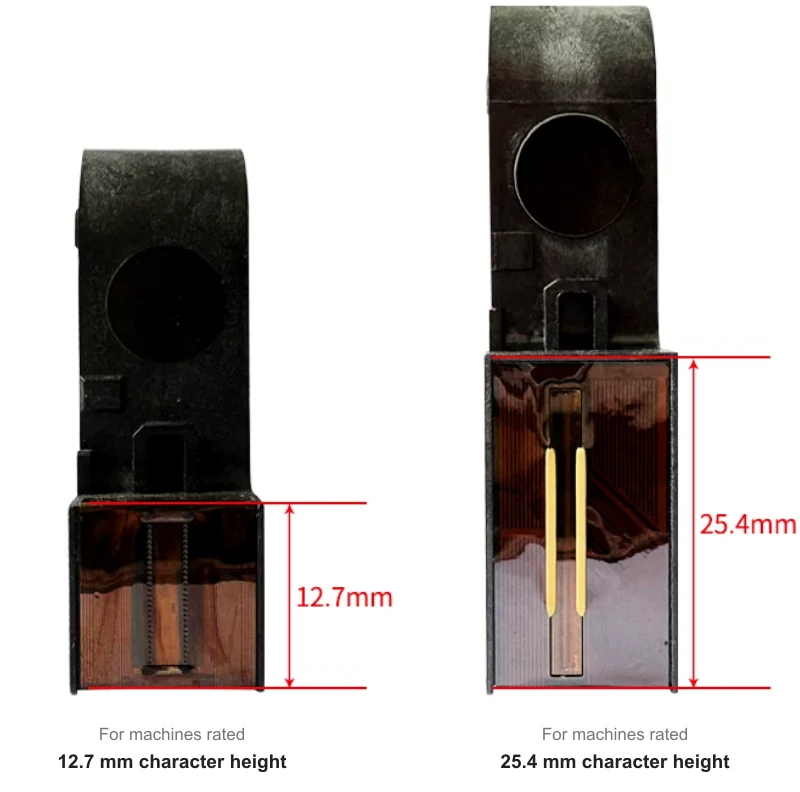
- 12.7 mm and 25.4 mm
- Six colours including white
- Open, non-encrypted chip
Covert UV Ink Cartridge
No visible colourant in daylight. The mark is read under a 365 nm source, which makes it a tool for authentication, traceability and warranty control rather than for reading.
- Invisible in daylight
- Read at 365 nm
- Anti-counterfeit marking
- Same HP45-format body
Four questions that narrow it to one cartridge
Does the surface absorb water?
If it does — carton, paper, wood — a water-based grade already works and costs less. If it beads, start with solvent.
Does the mark need to be seen at all?
For a visible code, solvent with a standard colour. For a mark that must not be visible to whoever handles the pack, the covert UV cartridge.
One line, or something denser?
A single date, batch or serial line fits a 12.7 mm body. A QR or Data Matrix sharing the band with a date line wants 25.4 mm, or the symbol shrinks below what scanners accept.
What must the code survive?
Handling and stacking at minimum. Refrigeration, freezing, condensation or a solvent wipe each need testing on your own material.
What the format fixes, whatever the ink
Both families ride the same HP45-format thermal inkjet platform: 300 nozzles to a row at 1/300 in pitch, native 300 dpi rising to 600 dpi in some print modes, drop volumes in the 29–38 pl range, fire frequencies around 12–18 kHz, and an optimum throw distance of 1–2 mm — usable to about 5 mm at some cost in placement accuracy.
Print width is a property of the cartridge rather than a software setting: 12.7 mm on the half-inch body, 25.4 mm on the one-inch. No controller setting changes that, which is why the width question has to be answered before the printer is chosen.
The platform figures describe the format, not your material. Drying, adhesion and resistance to whatever the pack meets afterwards are properties of the ink and the surface together, and they get settled by a sample on your line.
Two bodies, and what the nozzle row changes
Print width is a physical property of the body, not a setting. The half-inch body carries a 12.7 mm nozzle row, the one-inch carries 25.4 mm, and during a pass that row becomes the height of the band left on the product. Both bodies sit in the same format and take the same carriage seat — what changes is how much content goes down before the character height has to shrink to make room for it.
| What you print | 12.7 mm body | 25.4 mm body |
|---|---|---|
| Single date, batch or serial line | Comfortable | Comfortable, with more air around the characters |
| Two short lines | Only at a reduced character height | Comfortable |
| QR or Data Matrix plus a date line | The symbol shrinks until scanners start rejecting it | The realistic choice |
| Handheld unit weight | Lighter, easier over a long shift | Heavier, and the carriage has to accept the body |
The right-hand column is not an upsell. When a QR or Data Matrix symbol has to share the band with a date line, 12.7 mm forces the symbol small enough that end-of-line scanners begin missing it, and a rework station costs more per week than the cartridge difference. The opposite mistake is just as common: a one-inch body printing nothing but an 8 mm date code leaves most of its nozzles powered but idle, which is usually where the drying and clogging complaints originate. Our width audit works through the measurement before you order either.
The body also decides the machine, not the other way round. The 12.7 mm handheld coder prints a single line with the lighter unit, while the 25.4 mm handheld coder takes the wider body for multi-line text, logos and 2D codes in one pass.
What an open chip does, and does not, mean
Buyers meet these cartridges under two names. Suppliers write open chip, because it describes what the printer does with it. Purchasing and technical teams write non-encrypted, because it describes why. Both describe the same thing: no OEM authentication chip the printer has to handshake with before it will fire, no single-use lock-out, and no firmware gate that rejects a cartridge for not being an original part.
Two things it does not mean, and both are worth stating plainly. An open chip is not a blank or cloned chip. It is also not a refilled original — we build, fill and test these bodies ourselves, and the printer is simply never asked to authenticate them. Nor does the chip say anything about what is inside it: chip and ink system are separate decisions, and the wrong ink in a perfectly accepted cartridge fails just as completely.
The practical value is a second source you can test rather than a compliance argument. An open-chip body can be qualified alongside your existing supply, on your own line, while your operators compare print quality, drop-out behaviour and cost per mark. If the sample does not convince them, nothing about your current setup has changed.
The number on the label, and what it does not tell you
TIJ 2.5 and HP45 are two names for one physical format. The number printed on the body is a commercial label rather than a specification: the same shell leaves different factories under different numbers, because fillers, distributors and end customers each carry their own. It multiplied for commercial reasons, not technical ones.
| Number | Ink direction | Width | What the number settles |
|---|---|---|---|
| 45A / 51645A | Aqueous pigment, black | 12.7 mm | The number most buyers search for. A deskjet ink, not a coding ink |
| 2580 | Mild solvent, high adhesion | 12.7 / 25.4 mm | The high-adhesion end of the family: coated metal, glass, PET, coated film |
| 2588 | Oil-based fast-dry | 12.7 mm | The packaging workhorse: PE bags, cartons, general secondary packaging |
| 2590 / W3T10B | Solvent | 12.7 mm | Smaller drop, faster dry, aimed at film at higher optical density |
| B3F58A / B3F58B | Solvent fast-dry | 12.7 mm | Sold for foil and blister lidding on intermittent lines |
| B9F16A + colour suffix | Solvent fast-dry | 12.7 mm | A bare number identifies no colour; number and colour are two different products |
Three things the number cannot do, and each one has cost a buyer a production run. It cannot tell you the part is original — a number shaped like an HP part number does not make an original part. It cannot tell you the formulation — two suppliers can fill the same number with different inks, so colour and chemistry stay unconfirmed until someone reads the label on the body itself. And it cannot tell you whether the ink will hold on your material at all.
Width is the one fact the number does carry, and it is physical rather than nominal. A one-inch body cannot stand in for a half-inch one: it will not seat in the carriage, and the band would not fit the layout even if it did. Our guide to what the HP 45A name means takes the same list and turns it into six fields worth confirming, and the generation question covers what happens when the shell is shared but the electronics are not.
What settles it is smaller than a table: the printer make and model, a photograph of the label you are replacing, the material, and the code content. Send those four and the answer stops being a guess.
Provenance. The values above come from public trade information about this format, not from measurements we have taken. Ink direction and width are the columns we would rely on; treat everything else as a starting point for a label check, and ask us before ordering against a number we have not quoted you.
The ink follows the surface, not the other way round
A liquid wets a solid when the solid's surface energy is higher than the ink's surface tension — and the margin has to be comfortable. Roughly 8–10 mN/m above the ink is the working rule; a couple of units is not enough, even when it reads like a pass on paper.
That one threshold explains most adhesion complaints we are sent. Polyolefins sit below it: HDPE around 28–32 mN/m, PP around 26–28. PET sits above it at 40–42. So the same solvent ink that flakes off an untreated HDPE bottle can hold perfectly on a PET one, which is why "plastic" is too broad a word to choose an ink by. Corona and flame treatment decay in storage, and where a primer or lacquer is involved, the coating becomes the surface you are actually printing on.
42 ml is a fill, not a lifetime
The body is rated for a 42 ml industrial fill, and industrial fill is a specific claim worth pinning down. A cheaper "service fill" cartridge often carries noticeably less ink in the same shell, because the shell cannot easily be reduced and the ink is the easiest thing to cut. Ask for the figure in millilitres rather than trusting a page count.
What 42 ml does not do is convert into a number of marks. Life is governed by character height and content density, so a single-line date code and a multi-line block carrying a QR code can differ several times over on the same fill. Idle time takes its cut as well: a body that sits between shifts loses ink to maintenance prints and nozzle recovery, and that loss never appears in a per-mark calculation. Our bench test of how much a 42 ml cartridge really delivers measures that gap instead of repeating the label, and the cap-off clock covers what a pause of each length costs you.
So we publish the fill and nothing about life. Send the code content, the character height and the print width, and the figure gets worked out against your requirement rather than quoted as an industry average.
Minimums and custom work
Standard black TIJ ink starts at 50 cartridges. Specialty colours — white and yellow pigment formulations among them — start at 200–300, because they carry a heavier solids load and a different handling routine. Prices are quoted per order, since the figure depends on the ink system, the colour and the quantity.
Custom formulation reaches production within 4–6 weeks with our in-house team of 12 chemists and engineers. Private label, custom shell design and branded packaging are handled through the same OEM/ODM route.
Get Started
READY TO SCALE
YOUR PRINT OPERATION?
Send us your printer model and monthly volume. We'll respond within 24 hours with pricing, spec sheets, and sample availability.